

Deepen your knowledge - amaze your friends - give Merlin a break - British Birdsong Essentials, the ten-week learn-by-ear course, begins in two weeks
Of our three resident thrushes, the mistle thrush is the biggest but least often seen, being a wary bird of more open places such as parkland and pasture.
The song is like a rushed blackbird.
It’s a brief torrent of fluty notes, something like a turn on a toy carousel. Then a brief pause. Then another round.
Mistle thrushes tend to choose the very highest perches to sing from. Such height often lends their voice a detached quality.
This effect is heightened by their habit of singing during wet and windy weather, when most other birds go quiet.
This can give us a strong clue to a lone singer on a rough day.
It’s also the behaviour that inspires their traditional name of ‘stormcock’.
A neat way to think of the differences between the songs of blackbird, song thrush and mistle thrush comes from Dominic Couzens.
The idea goes something like this: thrushes are all teachers.
Blackbirds make good teachers, because they speak slowly and leave long pauses for you to write down what they’ve said.
Song thrushes are good too, because they repeat everything a few times for you to remember.
Mistle thrushes, however, are not so good, because they talk too quickly, don’t repeat, and don’t leave enough gaps to write it all down.
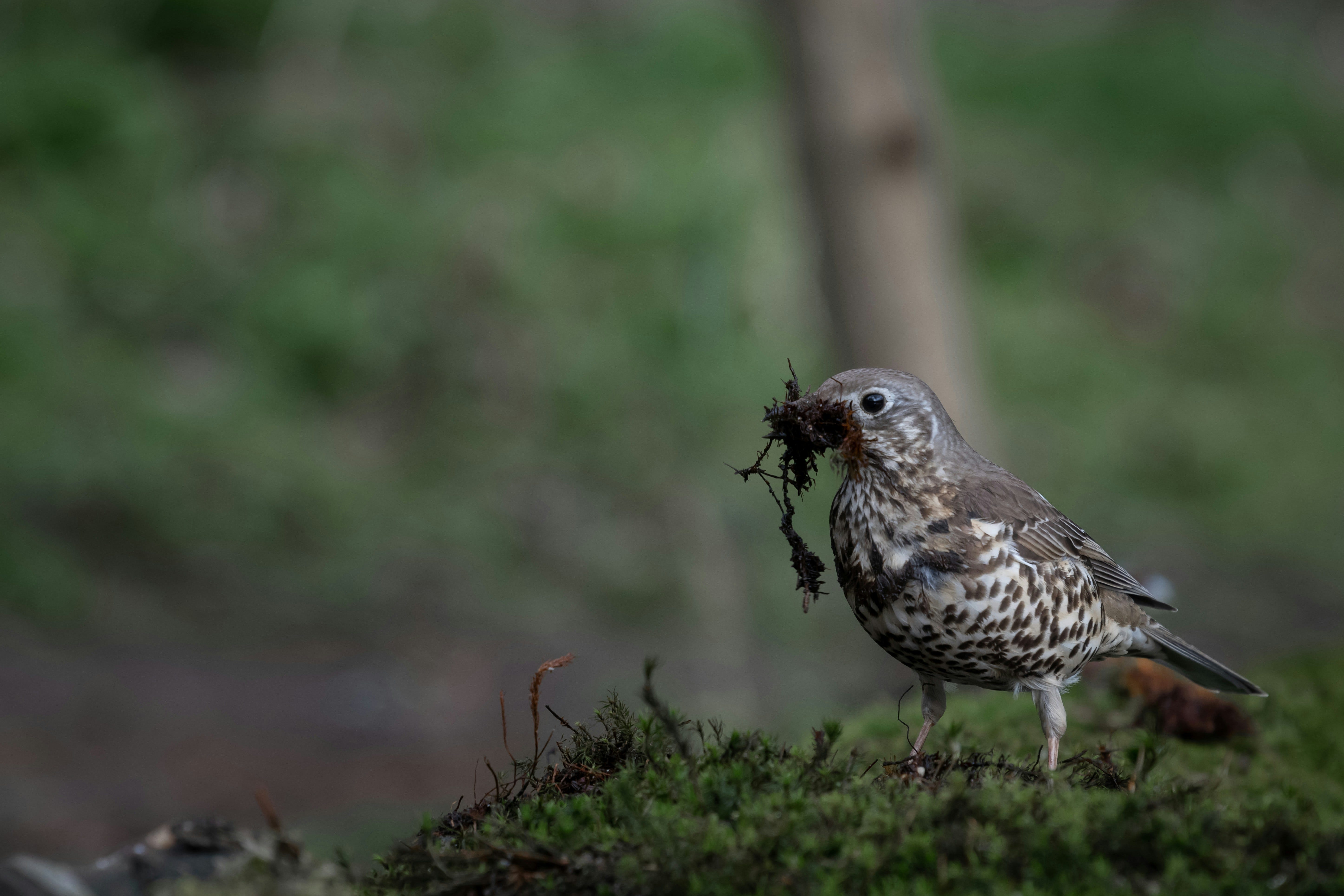
On the ground a mistle thrush can appear superficially like a song thrush - brown on the back and strongly speckled underneath.
A closer look reveals the greyness on the head and wings, the longer tail and the blobby, rather than arrowhead-shaped speckling.

When they fly, they show white under the wing, rather than the buff-yellow of song thrush.
They’re noisy travellers too. The harsh rattling call given in flight and during confrontations carries a long way, especially when it’s being deployed at high intensity to chase off unwanted company.
This can make the mistle thrush seem somewhat angry birds. Perhaps that’s as it should be, for while humans profess love under a sprig of mistletoe, these birds prefer to tear off the berries and excrete them from a great height.
So for mistle thrush, remember:
often sings in the rain
from the tallest perch
less tuneful, more rushed than blackbird
with a harsh rattle.
Mistle thrushes are widely but thinly distributed in Britain, with an estimated 165,000 territories, some 60% fewer than in the 1960s. They are resident across much of Europe, and summer visitors to northern latitudes and central Asia.
Read more about their behaviour, including their apparent co-operation with chaffinches, in Dominic Couzens’ article in Birdwatching magazine.
There’s a Shriek of the Week every weekend, January to June.
This is the sixth instalment in 2026’s cycle of Shriek of the Week. You can catch up with Blackbird, which includes more about how the whole thing works, as well as Robin, Wren, Song Thrush and Great Tit.
For those who can, taking out a paid subscription supports me to write more and improve what I do. It also gets you full access to the A-Z archive, and an invite to the monthly Early Bird Club call - our next is 8am GMT on Sunday 8 March.
Media credits:
Thanks to Fintan O’Brien for his mistle thrush recording.
First photo de Vincent van Zalinge sur Unsplash
Second photo by TheOtherKev on Pixabay


