

A forest dweller, dwindling in numbers in Britain, the ‘spinning coin’ song of the wood warbler can still be heard in western woodlands from late April until June.
The phrase can be heard as something between the 8-bit explosion of the corn bunting, the sweet descent of the willow warbler and the penetrating trill of the wren.
It’s well described as the sound of a spinning coin coming to rest.
In the 18th century, naturalist Gilbert White wrote that the wood warbler ‘haunts only the tops of trees in high beechen woods, and makes a sibilous grasshopper-like
noise, now and then, at short intervals, shivering a little with its wings when it sings.’
White’s diligent observations at Selborne in Hampshire recognised this bird to be different from both the willow warbler and the chiffchaff. All three had tended to be lumped in as variations of the same species, the ‘willow-wren’.
These are differences that may seem slight in the hand (and ‘in the hand’, in the 18th century, generally meant deceased).
It’s the birds’ voices, only available when alive, that more clearly differentiate them. It was White’s careful observations of living birds in his parish that helped reveal their true nature.
Binoculars, telescopes and cameras make the visual differences a little easier to spot now.
Globally, there are dozens of members of the leaf warbler family, to which wood warblers, willow warblers and chiffchaffs belong. Most are, more or less: green on top, lighter underneath and with a pale stripe over the eye. They’re all rather small, and many turn up as vagrants on our shores, generally in the autumn, ready to befuddle and bewitch waiting birders.
Wood warblers are among the most clearly-marked members of the family. Adults in spring have a strong dark mark across the eye and a yellow chest that contrasts with a white belly.
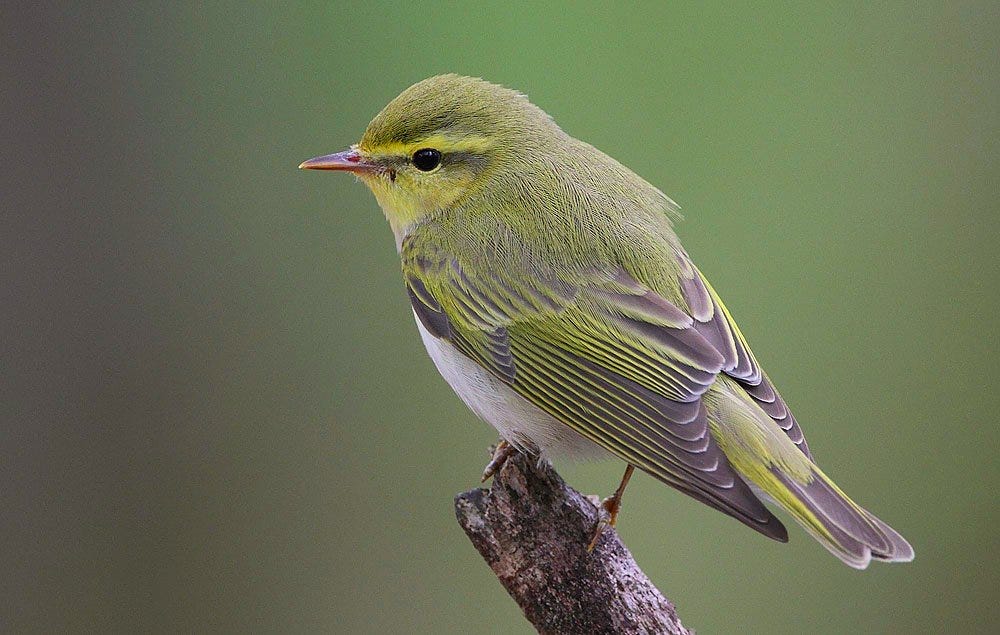
They are however vanishing quickly from our woodlands. Some 8 out of 10 disappeared from Britain between 1995 and 2023.
Like the cuckoo, the tree pipit and the spotted flycatcher, they seem to be abandoning the south and east of England - Gilbert White’s Hampshire patch included - perhaps as our lowland woodlands becomes too dry and warm for them.
The 8,000 or so pairs that continue to come here each summer seek out the cooler oak woods of the Atlantic edge, from Devon to the west of Scotland, in the company of the pied flycatchers and the redstarts and the mosses.
Protecting and expanding the remnants of our temperate rainforest may be the only chance for this ‘sibilant shiver’ to be heard here much longer.
Wood warblers can be found in summer across central and northern Europe, and in winter in central Africa, south of the Sahara. For more on the ecology of the wood warbler in Britain, visit the BTO website.
Find out more about the UK’s temperate rainforest from The Wildlife Trusts.
This is the 18th instalment in 2026’s cycle of Shriek of the Week. You can catch up with Blackbird, which includes more about how the whole thing works, as well as Robin, Wren, Song Thrush, Great Tit, Mistle Thrush, Treecreeper, Woodpigeon, Long-tailed Tit, Chiffchaff, Linnet, Lapwing, Willow Warbler, Sand Martin, Nightingale, Meadow Pipit and Lesser Whitethroat.
Thanks to all of those who support, whether that’s by taking out a subscription, leaving a comment, or sharing Shriek of the Week with others. It’s really appreciated.
The paid level gets you full access to the A-Z archive, and an invite to the monthly Early Bird Club call - our next is 8am BST (GMT+1) on Saturday, 6 June.
If you would like access to the paid level resources but it’s too much of a financial stretch, you can get in touch for a year’s free access.
Media credits:
Image by Steve Garvie from Dunfermline, Fife, Scotland, CC BY-SA 2.0, via Wikimedia Commons
Wood Warbler audio in narrated version by Olivier_Pichard via Freesound CC BY 4.0


